
Data & Communication Cables
Data and communication cables cover structured cabling for LAN and IT networks, industrial communication wiring in electrically noisy environments, and fiber optic infrastructure used in buildings and industrial sites. Ecables supports project-driven procurement and standards-aligned sourcing with documentation coordination for data and communication cable supply across Europe. For the full product range see our Products hub.
What Falls Under Data & Communication Cables?
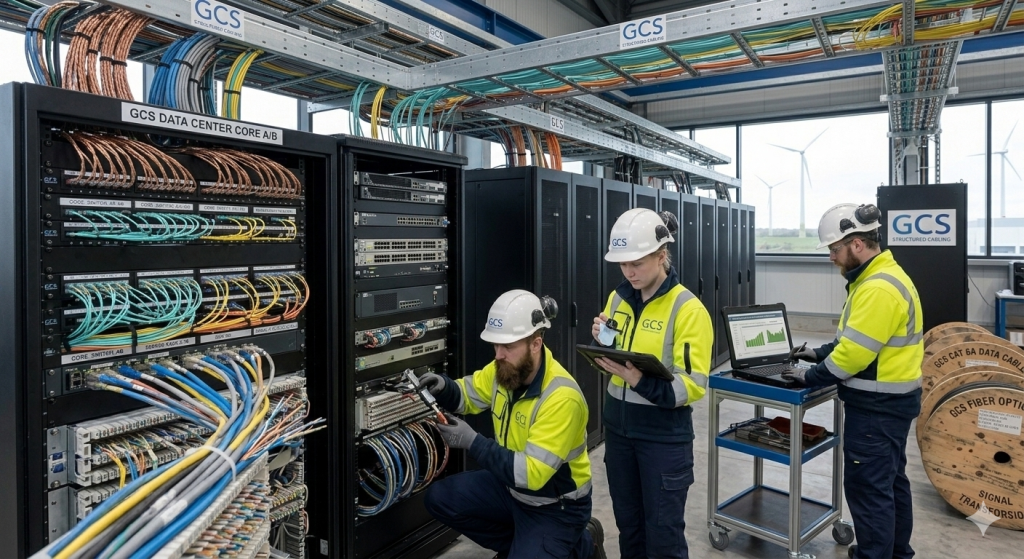
Data and communication cables encompass several application families. Copper twisted-pair (balanced) cabling is used for Ethernet and structured cabling in buildings and campuses; category-based designs (e.g. Cat5e, Cat6, Cat6A) support different bandwidth and distance requirements depending on installation and system design. Industrial communication cabling serves control networks, fieldbus and industrial Ethernet in environments where electromagnetic interference and mechanical stress must be considered. Fiber optic cabling is used for backbones, uplinks and long-distance links where copper reach or bandwidth limits apply. Application and installation context drive selection; no single cable type suits all use cases.
Copper Twisted Pair Cabling: Categories and Use Cases
Category families (Cat5e, Cat6, Cat6A and beyond) are used for structured cabling; achievable performance depends on category, channel length, installation quality and active equipment. Higher categories support higher bandwidth potential over specified distances under defined conditions—no categorical claim applies to all link lengths or installations. Design and verification should follow applicable cabling standards (e.g. ISO/IEC 11801, EN 50173, TIA-568) and project requirements.
- Bandwidth and distance targets for the link
- Installation environment (indoor, riser, plenum, industrial)
- EMC and shielding requirements
- PoE and thermal considerations where power is carried
- Installation constraints and cable routing

Shielding, EMC and Installation Environment
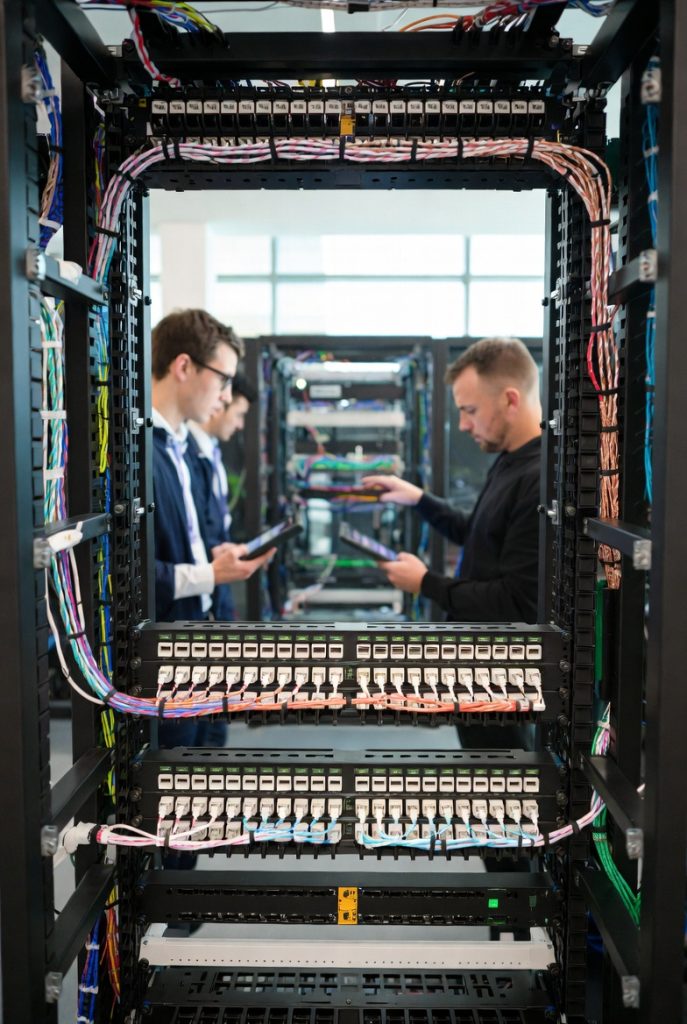
Structured and industrial data cabling may be unshielded (U/UTP), foil-screened (F/UTP) or screened and foil-shielded (S/FTP), depending on EMC and noise environment. Shielding helps reduce coupled noise; effectiveness depends on screen type, grounding and installation practice. In industrial or electrically noisy environments, shielded (screened) options for control and signal cabling are often specified. Correct termination and bonding are essential; cable routing and separation from power circuits influence EMC performance. Ecables supports specification review for data and communication cables in building and industrial applications.
Data cabling requirements often overlap with industrial control and instrumentation wiring, especially where EMC exposure, shielding practice and documentation expectations are similar. For control wiring in automation systems, see Control Cables. For signal-critical applications and twisted-pair constructions, see Instrumentation Cables. Where project specifications require reduced corrosive gas emission in enclosed installations, halogen-free (LSZH/LSOH) constructions may be specified.
Fiber Optic Cabling for Backbones and High-Density Networks
Fiber optic cabling is used for backbone and uplink applications, long-distance links and high-density connectivity where copper reach or bandwidth limits apply. Single-mode and multi-mode fiber are design choices driven by distance, data rate and cost; connectorisation and splicing form part of the installation scope. Ecables coordinates sourcing of fiber and copper data cabling with documentation aligned to project requirements. Selection should follow project topology and applicable cabling standards.
Fire Safety, LSZH Materials and CPR Context
Where data and communication cables are permanently installed in construction works within the EU, the Construction Products Regulation (CPR) and EN 50575 may apply; classification is test-based. LSZH (low smoke zero halogen) or halogen-free materials are often specified to reduce corrosive gas emission and smoke density in the event of fire; they are not equivalent to fire-resistant circuit integrity, which is a separate performance objective. For fixed building installations, see our Building & Construction hub for cable types and CPR context. For halogen-free cable options see Halogen-Free Cables.
Standards, Documentation and Procurement Requirements
Structured cabling design is often referenced to standards such as ISO/IEC 11801, EN 50173 and TIA-568; these provide design frameworks and performance categories rather than mandatory compliance in all jurisdictions. Documentation expectations include product data sheets, test reports where applicable (e.g. IEC 60332, 60754, 61034 for fire/smoke/acidity where relevant), CPR Declaration of Performance where cables are used in construction works, and traceability. For general standards context see IEC standards.
Procurement Requirements
Procurement Steps
- Application and topology definition – Link types, distances and data rates.
- Environment and EMC review – Indoor/outdoor, shielding, routing.
- Material and fire performance requirements – LSZH, CPR class, where applicable.
- Documentation alignment – DoP, data sheets, test evidence as required.
- Quotation and delivery planning – Quantities, lead times and logistics.
Request Data & Communication Cable Supply for Your Project
Submit your cable schedule, specification or project requirements. We will respond with clarification, a structured quotation and documentation options for data and communication cable supply across Europe.